
Create Beats Through Rhythm, Structure, and Practice

-
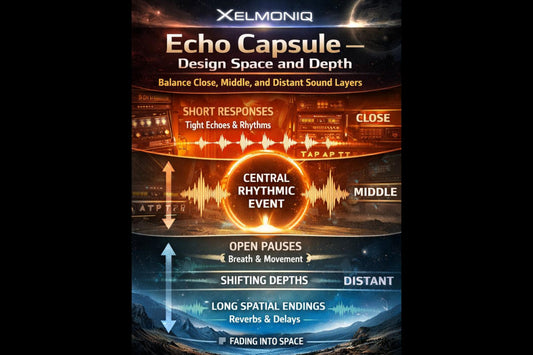
Echo Capsule
Regular price €219,00 EURRegular price -
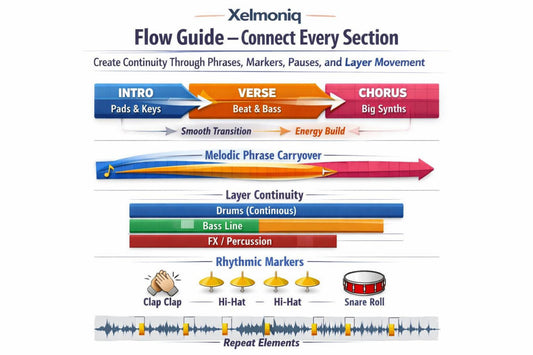
Flow Guide
Regular price €191,00 EURRegular price -
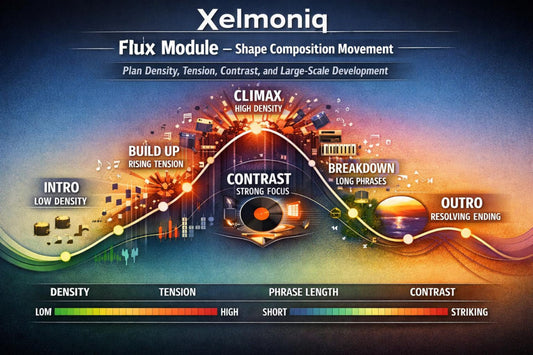
Flux Module
Regular price €174,00 EURRegular price -
-
-
-
Nexus Series
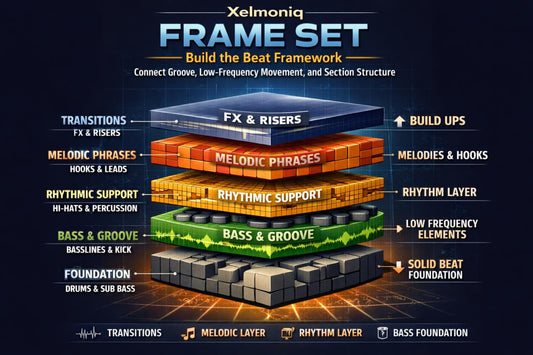
Regular price €302,00 EURRegular price -
Pulse Pack
Regular price €70,00 EURRegular price








As seen on


Xelmoniq Was Shaped Between Rhythm and Structure
The People Behind Every Bar
-

Calder Vossn
Rhythm Pattern Composer
Calder focuses on rhythmic patterns with different density levels, accent structures, and pause placement. He studies how small changes inside one bar can influence the complete rhythmic cycle. His materials help learners view a pattern as a connected system rather than a random group of hits. -

Brielle Camden
Beat Transition Designer
Brielle works with transitions between short sections and larger composition blocks. She uses pauses, gradual layer replacement, motif returns, and density changes to connect different parts. Her materials show how to prepare a new section without abruptly interrupting the overall rhythmic direction. -

Rowan Whitaker
Percussion Programming Specialist
Rowan focuses on supporting percussion elements, rhythmic responses, and details that reinforce the main pulse. He works with accent placement, varied hit strength, and different rates of appearance. His approach supports rhythmic movement without filling every part of the bar.


Rhythm Has Its Own Logic
Learning Arranged Bar by Bar
-

Clear Structure
Each course is divided into connected modules that move from foundational concepts to extended composition assignments.
-

Practical Focus
Written explanations are supported by exercises, diagrams, tables, and independent study tasks.
-

Flexible Pace
Learners can review the materials in a comfortable order and spend more time on topics that require additional practice.
-

Offline Learning
The materials can be downloaded to a personal device and used without a continuous internet connection.



30-Day Refund Window
When Rhythm Becomes Practice
-

Nolan Pierce
Nolan was already creating short rhythmic loops, but he found it difficult to develop them into longer compositions with several connected sections. He often added new layers without defining their purpose, which caused the structure to become crowded. The section maps and explanations about changing density while preserving the central rhythmic motif were particularly useful to him.
“The section maps helped me see where a beat needed development and where it only needed more space.” -

Maren Whitmore
Maren had experience working with musical phrases, but she found it difficult to combine them with rhythm and low-frequency movement without excessive overlap. Several elements in her compositions often occupied the same positions and competed for attention. The diagrams separating central, supporting, and background layers, together with the exercises on open pauses, were especially useful to her. “The layer diagrams showed me that every sound does not need to be active at the same time.”


